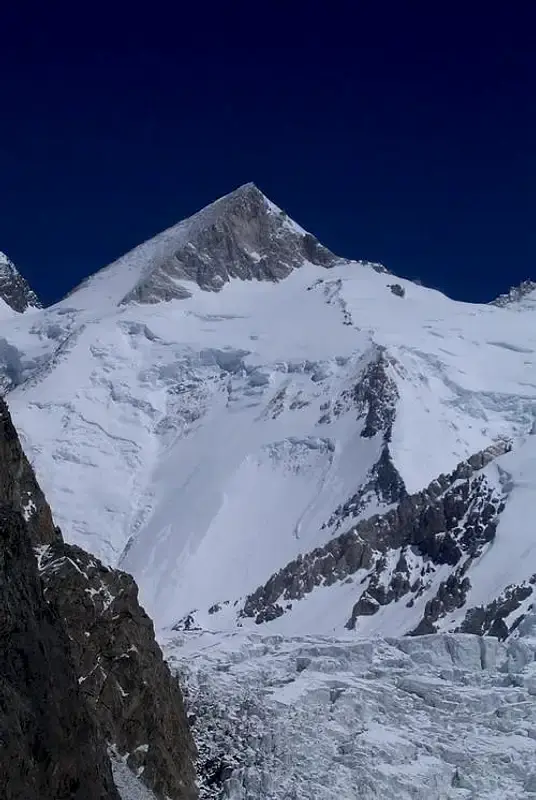
Gasherbrum II Feng is an 8034 m peak in the Pakistan Karakoram, on the border area near the China frontier. It is the 13th highest mountain in the world and one of the most climbed 8000ers, known for its relatively straightforward high-altitude profile compared with many neighboring giants. The mountain rises above the Gasherbrum massif, where long glacier approaches, severe weather, and thin air define every ascent.
Most expeditions approach via the Baltoro Glacier and Concordia, then continue into the upper Gasherbrum basin. The climb is still serious and demanding, but it attracts experienced mountaineers because the standard route is less technical than many other 8000 m peaks. Success depends on acclimatization, stable weather, and efficient logistics in a remote alpine environment.
The mountain is usually climbed in organized expeditions with fixed camps, rope support, and high-altitude assistance. Trekking access is also famous for its dramatic scenery, passing through Skardu, Askole, and the great glacier valleys of the Karakoram. For many visitors, the journey to base camp is as memorable as the summit attempt itself.
No users yet
No ascent logs yet. Be the first to log your climb!
The classic trekking approach to Gasherbrum II Feng follows the Skardu–Askole–Baltoro Glacier corridor, then continues through Paiju, Urdukas, Goro II, and Concordia. This is a long, remote glacier trek with camping, river crossings, and changing terrain from dry valleys to ice and moraine. It is best for strong trekkers who want a high-altitude expedition atmosphere rather than a short scenic hike.
A second option is the trek toward Gasherbrum Base Camp from Concordia. It is less crowded than the route to K2 base camp and offers wide views of the Gasherbrum peaks. The path is mostly on glacier and moraine, with cold nights and limited facilities. Trekkers need good fitness, proper acclimatization, and a support team for food, tents, and route finding.
The standard climbing line on Gasherbrum II Feng is the normal route from the Gasherbrum base camp up the southwest side. It is considered the least technical route on the mountain, but it still involves crevasses, avalanche exposure, and long sections above 7000 m. Climbers usually establish several camps and use fixed ropes on steeper or exposed parts. The main challenge is altitude rather than difficult rock or ice climbing.
Alternative lines are less common and are chosen by highly experienced alpinists seeking more direct or more technical ascents. These routes may involve steeper snow slopes, mixed terrain, and greater objective danger from weather and seracs. Because conditions change quickly in the Karakoram, most expeditions prefer the standard route, which offers the best balance of safety, logistics, and summit probability.
The nearest major populated center is Skardu, the main gateway for expeditions in the eastern Karakoram. From Skardu, travelers usually drive by jeep to Askole, the last village before the glacier approach begins. The trek starts from Askole and continues along the Baltoro Glacier toward Concordia and the Gasherbrum region. The road is rough and can be affected by landslides and weather.
Most visitors reach Skardu by domestic flight from Islamabad, though flights can be delayed by mountain weather. Overland travel is also possible via the Karakoram Highway, but it is much longer. From Askole, all further movement is on foot with porters, guides, and expedition support. Independent travel is difficult because of remoteness, permits, and logistics.
Climbing Gasherbrum II Feng requires official permits from Pakistan authorities, and foreign climbers usually need a registered expedition operator. Local guides and high-altitude porters are essential for transport, camp setup, route fixing, and emergency support. Costs vary by season, team size, and service level. For a full expedition, reputable operators often quote roughly USD 25,000 to 45,000 per climber, excluding personal gear and international flights.
Well-known and reliable agencies for Pakistan expeditions include Adventure Tours Pakistan, Jungle Trekking, Masherbrum Tours, Baltistan Tours, and Karimabad-based local operators with long Karakoram experience. Premium international expedition companies may charge more, often USD 40,000 to 70,000, depending on logistics and summit support. Always confirm permit handling, rescue policy, oxygen, and porter welfare before booking.
The best climbing window for Gasherbrum II Feng is usually from late June to August, when the Karakoram summer offers the most stable weather and the safest access to high camps. Many expeditions aim for summit attempts in July, after enough time for acclimatization and route preparation. Even in this period, storms, strong winds, and snowfall can interrupt progress, so flexibility is essential.
For trekking, mid-June to early September is generally the most practical season. Earlier in spring, snow conditions are colder and more unstable, while autumn brings shorter days and increasing cold. The Karakoram remains unpredictable, so teams should plan extra buffer days for delays on the road, at base camp, and during summit rotations.
For trekking, essential gear includes sturdy boots, layered clothing, a warm sleeping bag, trekking poles, gloves, sunglasses, a headlamp, and a waterproof shell. Because the route crosses glaciers and remote camps, trekkers also need a personal first-aid kit, water purification, and sun protection. A porter or support team usually carries tents, food, and cooking equipment, but each person should still be prepared for cold nights and sudden weather changes.
For climbing, mountaineers need high-altitude boots, crampons, ice axe, harness, helmet, ascender, descender, fixed-line gear, and expedition clothing for extreme cold. Oxygen is often used on summit day by many teams, along with radios, avalanche safety items, and a robust sleeping system. Technical gear should be tested before departure, since replacement options are limited once the expedition reaches the glacier.
Plan for slow acclimatization and do not underestimate the approach to Gasherbrum II Feng. The trek to base camp is long, and altitude begins to affect many travelers well before the summit zone. Carry cash in Pakistan rupees for local expenses, and keep extra time for weather delays, road closures, and flight cancellations in Skardu. A flexible itinerary is more realistic than a fixed one.
Use a trusted local operator, respect porter limits, and confirm rescue arrangements before departure. Mobile coverage is limited or absent on much of the route, so satellite communication is valuable for expeditions. Travelers should also respect local customs in Baltistan, avoid littering, and pack out all waste. Good preparation and patience are as important as fitness and technical skill.
Gasherbrum II Feng is often called one of the more accessible 8000 m peaks, yet it remains a major high-altitude objective with real objective hazards. It stands in a spectacular cluster of giant peaks near K2, Gasherbrum I, and Broad Peak, making the region one of the most dramatic mountain landscapes on Earth. The name Gasherbrum is commonly linked to the local meaning “beautiful mountain.”
The mountain was first climbed in 1956 by an Austrian team, and it has since become a classic expedition peak. Its summit is reached through one of the world’s most famous glacier journeys, where the route itself is a major attraction. Many climbers value Gasherbrum II Feng for its combination of grandeur, relative simplicity, and remote Karakoram atmosphere.
How high is Gasherbrum II Feng? It is 8034 m high and is one of the fourteen 8000 m peaks in the world.
Is Gasherbrum II Feng suitable for beginners? No. It is a serious high-altitude climb for experienced mountaineers with prior 7000 m or 8000 m experience.
How long does the trek to base camp take? The approach from Askole to the Gasherbrum base camp usually takes about 8 to 12 days, depending on pace and weather.
Do climbers need oxygen? Many expeditions use supplemental oxygen on summit day, but some experienced climbers attempt the peak without it.
What is the main access point? The usual gateway is Skardu, followed by jeep travel to Askole and then trekking on the Baltoro Glacier.
No posts yet.